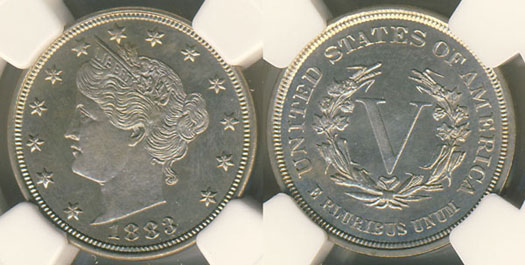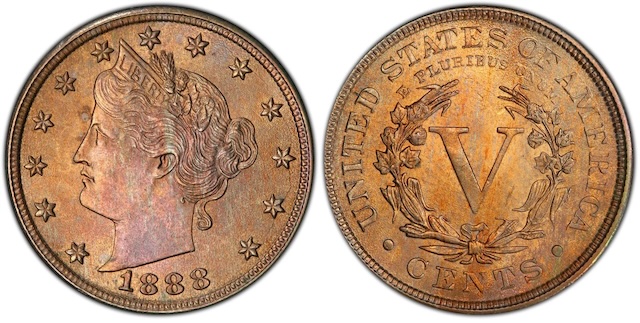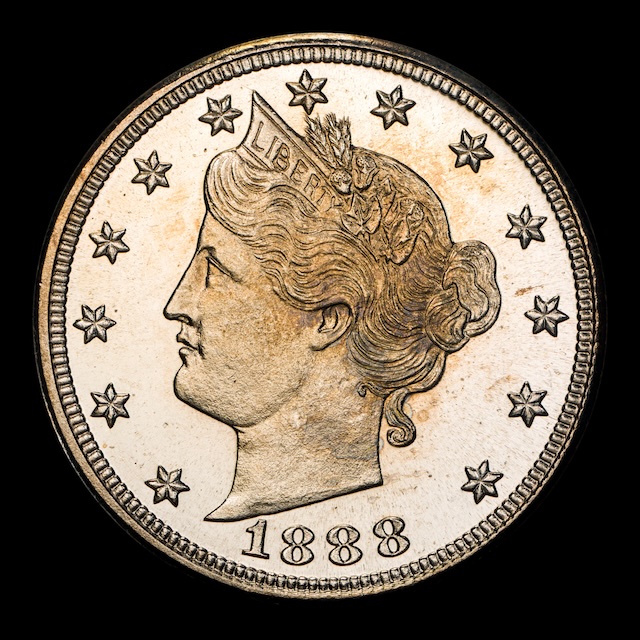
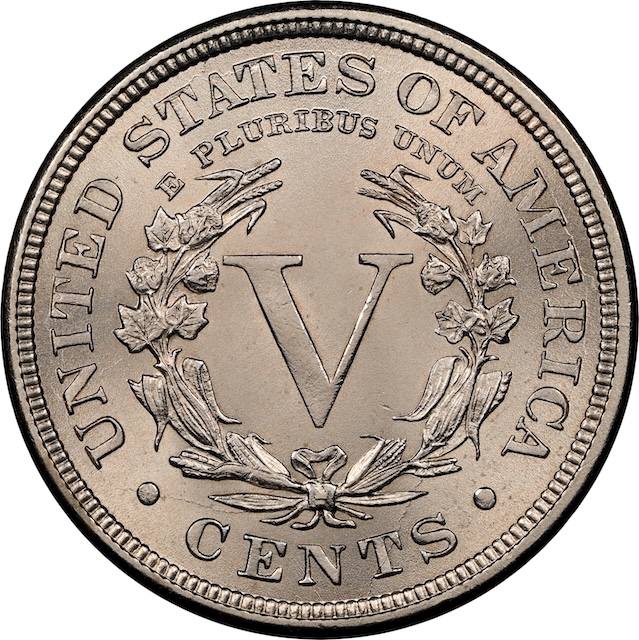
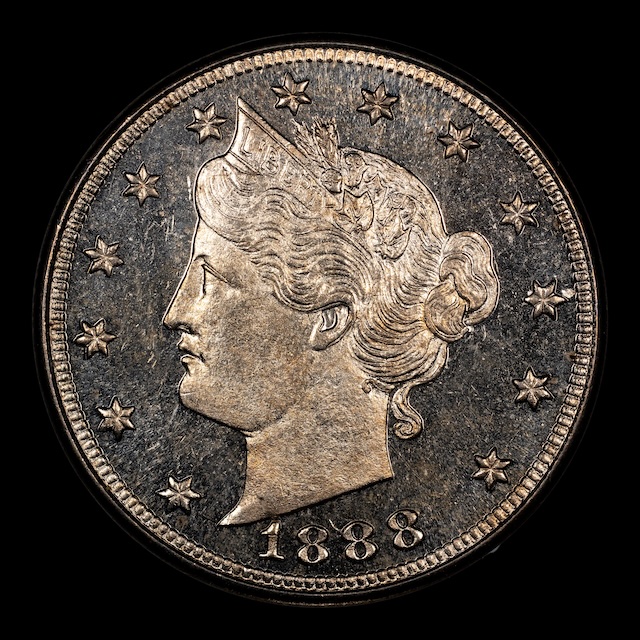
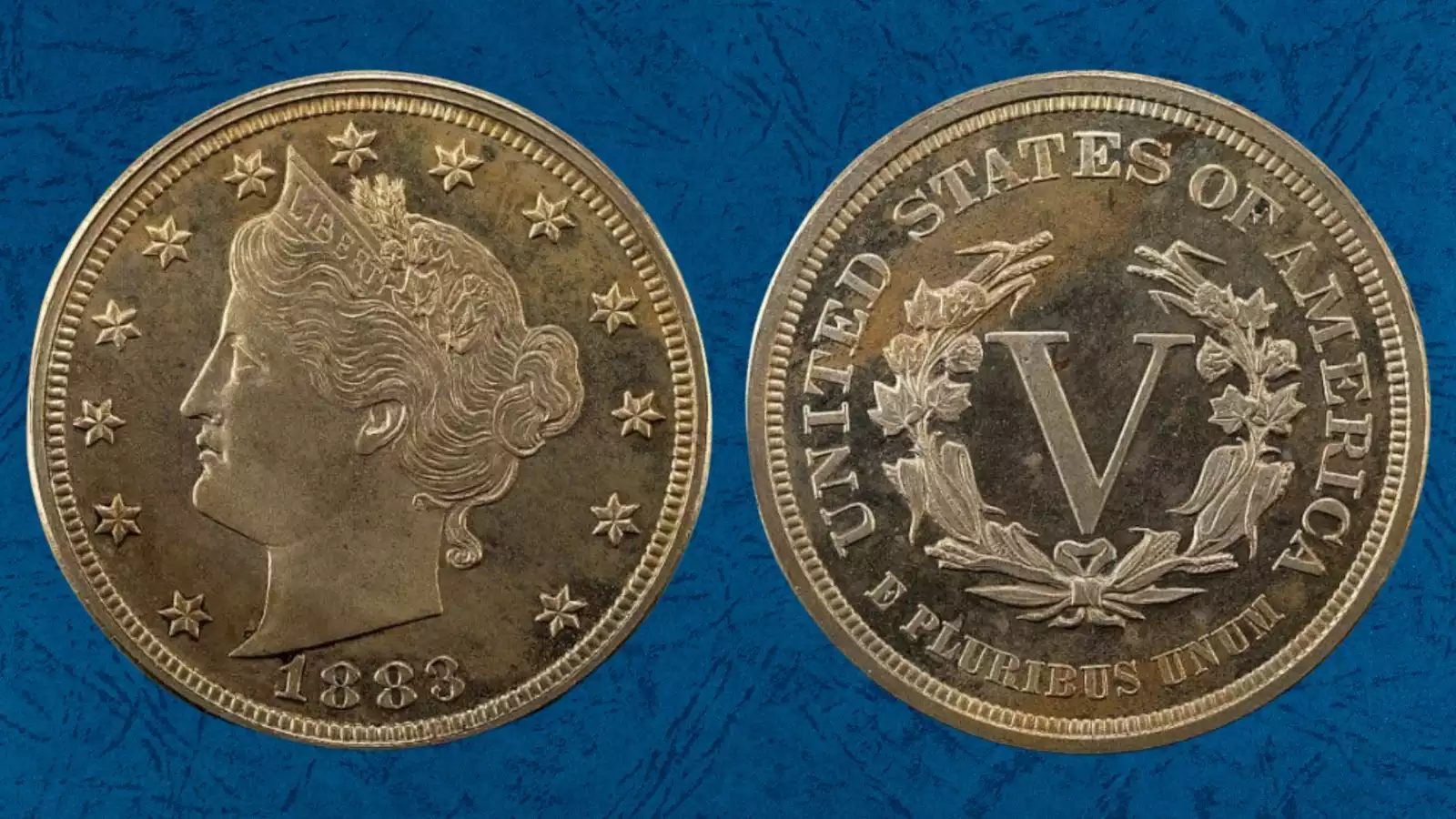
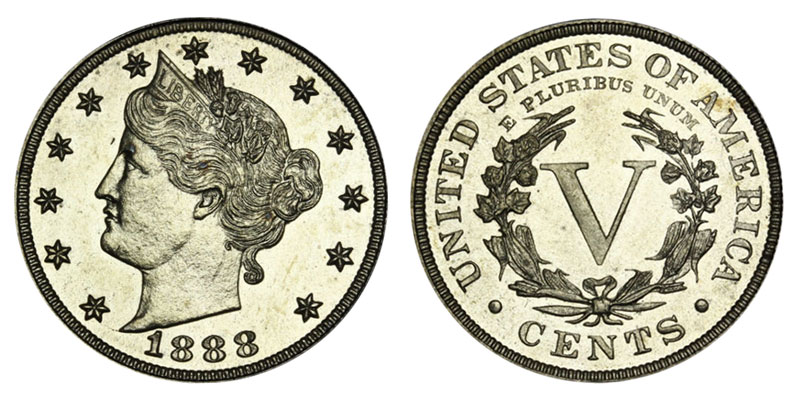
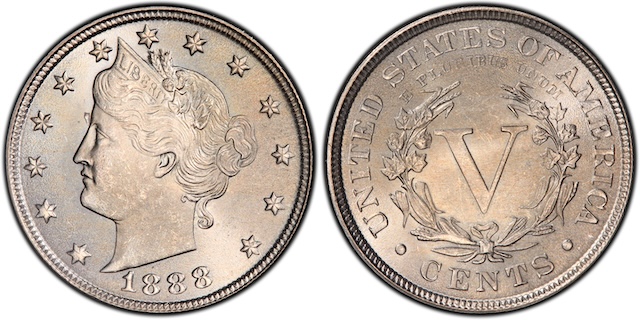
1888 Liberty Head V Nickel obverse and reverse showing Liberty portrait and Roman numeral V

The 1888 Liberty Nickel Value Guide

A gem-quality 1888 Liberty V Nickel graded MS66+ sold for $7,200 at Heritage Auctions — all from a coin that spent decades in a forgotten collection. Even worn examples in Good grade consistently fetch $20–$35 today. This semi-key date has fewer than 1,100 certified Mint State examples across all major grading services, and collectors actively compete for every quality piece that surfaces.

★★★★★ 4.8 / 5 · Trusted by 1,247 collectors
Check My 1888 Nickel Value →
$7,200 Top auction record (MS66+)
10.7M Business strikes minted
~1,076 Certified Mint State examples
6 Known die varieties

Free 1888 Liberty Nickel Value Calculator

Select your coin's mint, condition, and any known error varieties to get an instant value estimate based on current market data.

Step 1 — Mint Mark

All 1888 Liberty Nickels were struck at Philadelphia — no other mints.

Step 2 — Condition

Step 3 — Known Errors / Varieties

If you're not yet sure about your coin's mint mark or condition, there's a free 1888 Liberty Nickel Coin Value Checker tool that lets you upload a photo and get an AI-powered estimate without knowing those details first.

Describe Your 1888 Nickel for a Detailed Assessment

Describe what you see on your coin and our tool will analyze it for variety markers, condition clues, and estimated value range.

📋 Mention these things if you can

  • How clearly LIBERTY reads on the headband
  • Hair detail above Liberty's ear
  • Any doubling on date or letters
  • Condition of the reverse wreath and V
  • Presence of original luster / mint shine

💡 Also helpful

  • Any scratches, cleaning marks, or damage
  • Color: bright/silvery vs toned/dark
  • Rim quality and sharpness
  • Mirrored vs satin field appearance (proof vs business strike)
  • Any repunching visible under magnification

Skipped the calculator? Get an instant value estimate in 30 seconds.

Use the Free Calculator →

Is Your 1888 Nickel a Doubled Die Obverse (DDO)?

The DDO FS-101 is the most sought-after variety for this date. Use this visual checklist to see if your coin shows the diagnostic doubling.

1888 Liberty Nickel regular strike versus DDO FS-101 doubled die obverse comparison showing date and LIBERTY doubling

🔵 Regular 1888 Liberty Nickel

  • Date numerals appear crisp and single
  • LIBERTY on headband shows no shadow or secondary impression
  • Stars around the portrait appear sharp and singular
  • Worth $20–$625 depending on grade
— VS —

🟡 DDO FS-101 — The One to Find

  • Visible secondary impression on the date, especially the second "8"
  • LIBERTY letters show a slight "echo" or doubling under 10× loupe
  • Doubling most pronounced at the "E" in LIBERTY and base of date numerals
  • Commands a meaningful premium at any grade level

DDO Checklist — Check What You See

1888 Liberty Nickel Value Chart at a Glance

The table below summarizes current market values across all major varieties and condition grades. For a more detailed step-by-step 1888 Liberty nickel identification walkthrough, the PCGS price guide and major auction archives are the most authoritative long-term references. Values shown reflect recent auction and dealer data and will fluctuate with market activity.

Variety Worn (G–VG) Circulated (F–XF) Uncirculated (MS60–64) Gem (MS65+)
DDO FS-101 ⭐ Signature Variety $40 – $80 $150 – $350 $500 – $900+ $1,500+
Regular Business Strike $20 – $35 $50 – $175 $295 – $625 $1,000 – $7,200+
Repunched Date (RPD) $35 – $65 $100 – $250 $400 – $750 $1,200+
Doubled Die Reverse (DDR) 🔴 Rarest $45 – $90 $180 – $400 $600 – $1,000+ $1,800+
Proof Strike (PR63–PR66) N/A N/A $350 – $650 $800 – $1,500+

🪙 CoinKnow lets you snap a photo of your 1888 nickel and instantly cross-check its variety markers against a database of certified examples — a coin identifier and value app.

The Valuable 1888 Liberty Nickel Errors — Complete Guide

The 1888 Liberty Nickel is documented with six die varieties, including three distinct doubled-die obverse types, two with concurrent repunched dates, one doubled-die reverse, and multiple repunched-date-only examples. The five most collectible varieties are profiled in full below. Use the sidebar to jump directly to any variety.

1888 Liberty Nickel DDO FS-101 doubled die obverse close-up showing doubled date and LIBERTY letters MOST FAMOUS

1888 Doubled Die Obverse — FS-101

$40 – $1,500+

The FS-101 Doubled Die Obverse is the flagship variety for the 1888 Liberty Head Nickel and the variety most actively hunted by cherrypickers. It was created when the working die was hubbed twice with a slight rotational misalignment, leaving a permanent secondary impression on every coin struck from that die.

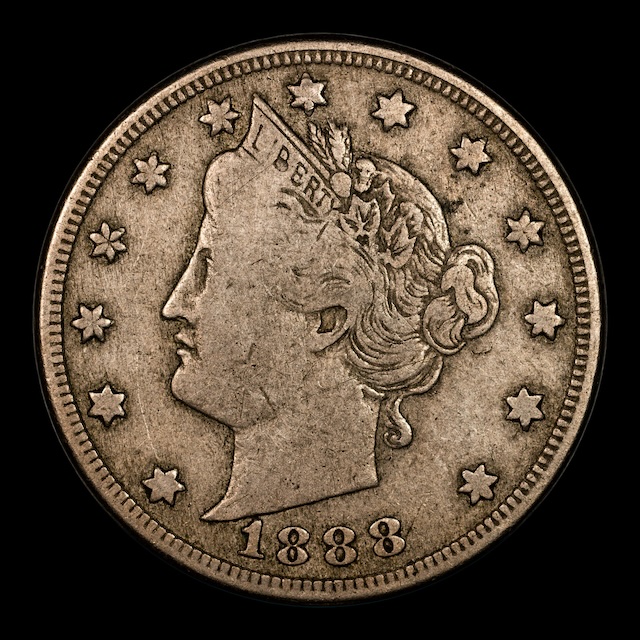
Diagnostically, the doubling appears most prominently at the date numerals — particularly the second "8" — and on the letters of LIBERTY inscribed on Liberty's headband. Under a 10× loupe, collectors will see a distinct offset shadow or "echo" following the primary letterforms exactly, not a random distortion. The "E" in LIBERTY and the base of the final "8" in the date are the two easiest diagnostic points to confirm.

This variety commands a premium because it carries the official CONECA designation and appears in the Cherrypickers' Guide with the FS-101 attribution number. Certified examples in any grade are actively traded, and the premium is most pronounced in Fine through Uncirculated grades where the doubling remains clearly visible despite wear.
How to spot it

Use a 10× loupe and examine the second "8" in the date from directly above. A clear secondary impression offset slightly clockwise from the primary numeral confirms the DDO. Also check the "E" and "R" in LIBERTY for matching secondary thickness.

Mint mark

Philadelphia only (no mint mark), the sole striking facility for 1888 Liberty Nickels.

Notable

Listed as FS-101 in the Cherrypickers' Guide (CONECA designation). Greysheet catalog GSID 346848 covers this variety. Certified examples have appeared at Heritage Auctions and PCGS-certified DDO examples regularly trade at 30–60% above regular-strike prices at comparable grades.

1888 Liberty Nickel repunched date close-up showing secondary digit impression at base of date numerals RAREST

1888 Repunched Date (RPD)

$35 – $1,200+

The 1888 Repunched Date variety (RPD) results from the date being hand-punched into the working die and then re-entered in a slightly different position before the die entered service. This was a routine risk in 19th-century die production when dates were applied manually with a separate punch rather than being part of the master hub.

Collectors can identify the RPD by examining the base and serifs of the individual date digits under 5–10× magnification. The most diagnostic feature is a ghostly secondary impression of one or more numerals — typically appearing below or slightly to the side of the primary digit. Some 1888 RPD examples compound with a DDO, creating a doubly collectible piece that shows both hubbings and a repunched date simultaneously.

The RPD variety is considered the rarest of the major 1888 Liberty Nickel varieties in terms of certified population. Because it requires specialized knowledge to identify, many examples have passed through dealer hands unattributed, meaning population reports likely undercount the true survival rate. Attribution by a CONECA-registered attributor adds meaningful value.
How to spot it

With a 5× to 10× loupe, inspect the lower serifs of the "1" and the curve of the first "8." A faint secondary digit impression — slightly misaligned and partially overlapping — confirms the RPD. The feature is most visible on lightly worn or uncirculated specimens where fine surface details remain intact.

Mint mark

Philadelphia only (no mint mark). A single striking facility produced all 1888 business strike Liberty Nickels.

Notable

Some 1888 RPD examples overlap with DDO characteristics, creating compound varieties noted by CONECA attributors. Liberty Nickel Collector Society (libertynickels.org) lists six distinct varieties for the 1888 date, and several of these include repunched date elements among the diagnostic features for attribution purposes.

1888 Liberty Nickel doubled die reverse close-up showing doubling on wreath and E PLURIBUS UNUM lettering MOST VALUABLE

1888 Doubled Die Reverse (DDR)

$45 – $1,800+

The 1888 Doubled Die Reverse (DDR) is distinct from the obverse doubled-die varieties — the doubling occurred during the hubbing of the reverse working die rather than the obverse. The result is visible hub doubling on the reverse design elements: the wreath, the Roman numeral V, and the motto E PLURIBUS UNUM above the wreath.

To identify the DDR, examine the reverse elements under a 10× loupe with a focused light source. The leaf outlines in the corn ear (lower left of the wreath), the ribbon, and the inner letters of E PLURIBUS UNUM are the most diagnostically reliable features. Doubling typically manifests as a distinct second impression inside or alongside the primary letter or design element, offset slightly from the original — not a simple thickening of the letters, which can indicate die wear.

Because reverse doubling is rarer and less frequently searched by collectors than obverse doubling, the DDR tends to be underattributed even on certified coins. Specimens with visible, clean DDR doubling at MS grades represent the highest-demand and highest-value examples in the 1888 variety category, often exceeding even strong DDO specimens when the doubling is particularly dramatic and well-documented.
How to spot it

Examine the reverse wreath under a 10× loupe with raking side-light. Focus on the corn ear at the lower left and the letters of E PLURIBUS UNUM. A clear secondary impression following the exact letterform confirms a true DDR rather than die deterioration doubling, which appears more irregular and flowing.

Mint mark

Philadelphia only (no mint mark). All 1888 Liberty Nickel business strikes came from a single facility — the Philadelphia Mint.

Notable

CoinWeek's collector guide for the 1888 Liberty Head Nickel confirms the existence of a distinct doubled-die reverse variety alongside the multiple obverse types. Because the DDR is less publicized than the FS-101 DDO, it remains undervalued in the broader market and represents a genuine opportunity for specialist variety collectors who search with a loupe.

1888 Liberty Nickel DDO Type 2 secondary doubled die obverse showing headband letter doubling distinct from FS-101 BEST KEPT SECRET

1888 Doubled Die Obverse — Type 2 (Non-FS-101)

$35 – $900+

Beyond the well-documented FS-101, the 1888 Liberty Nickel is known to have at least two additional distinct doubled-die obverse types documented by CONECA researchers. These secondary DDO varieties display different doubling patterns or affected areas than the flagship FS-101, and some also incorporate concurrent repunched-date characteristics.

The Type 2 DDO is most often identified by doubling that is more concentrated on Liberty's portrait features — particularly the hair details, the coronet, and individual stars surrounding the bust — rather than the date and LIBERTY primary diagnostic points of the FS-101. Because the doubling may be more subtle and affects less universally scrutinized elements, many collectors overlook it entirely, searching only for the prominent FS-101 pattern.

The collector premium for a non-FS-101 DDO variety is real but somewhat more modest than the FS-101 itself, as the FS designation drives much of the institutional demand. However, for advanced variety collectors who specialize in Liberty Nickels, any attributed doubled-die obverse type with clear diagnostics and a CONECA-recognized designation is a legitimate numismatic trophy piece worth actively pursuing.
How to spot it

Using a 10× loupe, examine Liberty's hair above the coronet and the individual stars to the left of the portrait. Secondary hub impressions on these peripheral design elements — particularly showing slight offset doubling on the star points or hair strands — indicate a non-FS-101 DDO type distinct from the date-focused FS-101 variety.

Mint mark

Philadelphia only (no mint mark). The 1888 issue was a Philadelphia-exclusive production throughout the entire year.

Notable

CoinWeek's detailed 1888 Liberty Head Nickel collector's guide explicitly notes three distinct doubled-die obverse types for this date, two of which also show concurrent repunched-date characteristics. The Liberty Nickel Collector Society lists six total varieties for the 1888 issue, making it one of the more variety-rich dates in the entire Liberty Head Nickel series.

1888 Liberty Head Nickel proof strike showing deep mirror fields frosted devices and squared rims COLLECTOR'S PRIZE

1888 Proof Liberty Nickel

$350 – $1,500+

The Philadelphia Mint struck 4,582 proof examples of the 1888 Liberty Nickel specifically for sale to collectors. Produced on polished planchets with specially prepared dies that were hand-fed into the press, proof nickels display characteristics that clearly distinguish them from business strikes: deeply mirrored fields that act like a mirror, cameo-frosted devices (Liberty's portrait and the reverse wreath), and precisely squared-off wire rims that result from the coin being struck two or more times at high pressure.

With nearly 1,939 examples certified across PCGS, NGC, and ANACS, proof 1888 Liberty Nickels show a relatively high survival rate compared to business strikes of similar or later dates. However, the quality spectrum within proof examples is wide — lower-end proof-63 coins with hairlines or reduced luster are far more common than pristine cameo or ultra-cameo designated pieces in proof-66 or better.

Collectors should distinguish genuine proof 1888 nickels from prooflike business strikes. Genuine proofs have fully squared rims visible with a loupe, deeply reflective fields with mirror-like clarity in both the obverse and reverse fields, and cameo-frosted devices. A business strike, even one struck from fresh dies, will not show all three characteristics simultaneously. Stack's Bowers sold a proof example in their 2023 Showcase Auction for $504 in a mid-level grade, demonstrating the active market for this issue.
How to spot it

Hold the coin under a strong single-point light source and tilt slowly. Proof fields will show a mirror-sharp reflection of the light source. Check the rim edge — proof coins display a sharp, fully squared-off wire rim under a 5× loupe. Business strikes have a slightly rounder rim profile, even from fresh dies, due to the different striking technique.

Mint mark

Philadelphia only (no mint mark). All 1888 proof Liberty Nickels were produced at Philadelphia, the only mint authorized for proof coinage at this time.

Notable

Stack's Bowers 2023 Showcase Auction realized $504 for a mid-grade 1888 proof example. PCGS, NGC, and ANACS have collectively certified approximately 1,939 proof examples, with the Liberty Nickel Collector Society ranking the 1888 proof population 29th of 31 issues — indicating a relatively generous survival rate compared to scarcer proof dates in the series.

Found one of these errors on your coin? Get an instant value estimate now.

Check Value with Calculator →

1888 Liberty Nickel Mintage & Survival Data

Philadelphia Mint historical building circa 1888 or tray of 1888 Liberty Nickel specimens at various grades
Strike Type Mint Mintage Certified Survivors (PCGS/NGC/ANACS) Survival Rate (approx.)
Business Strike Philadelphia (P) 10,715,901 ~1,076 in MS grades Extremely low in MS
Proof Strike Philadelphia (P) 4,582 ~1,939 certified High for proof issue
TOTAL 10,720,483 ~3,015 certified

Composition: 75% Copper, 25% Nickel  |  Weight: 5.0 g  |  Diameter: 21.2 mm  |  Edge: Plain (smooth)  |  Designer: Charles E. Barber (obverse and reverse)  |  Series: Liberty Head (V) Nickel 1883–1913

The 1888 Liberty Nickel's business-strike mintage of 10,715,901 ranks ninth among the 33 regular Liberty Nickel issues — neither a rarity by mintage alone, nor abundantly common. The semi-key status arises because most of these coins entered circulation and were heavily worn, melted, or simply discarded. The roughly 1,076 certified Mint State survivors rank sixth-rarest in MS grade across the entire 33-issue series, confirming that the 1888 is a legitimately scarce date in uncirculated condition despite its moderate mintage figure. Contextually, the Philadelphia Mint was heavily committed to Morgan Silver Dollar production in 1888, which constrained press time for smaller denominations.

How to Grade Your 1888 Liberty Nickel

1888 Liberty Nickel grading strip showing four examples from Good to Mint State with labeled condition tiers

🟤 Worn (Good–VG, G-4 to VG-10)

LIBERTY on the headband is only partially legible or worn smooth. Liberty's portrait shows as a bold outline but lacks internal detail. The reverse wreath and V are intact but flat. Rim is full. Values: ~$20–$40.

🟡 Circulated (Fine–XF, F-12 to XF-45)

All seven letters of LIBERTY are visible, though some (especially "I") may be faint in Fine grade. Hair strands above Liberty's ear begin to separate in VF. At XF, nearly all hair and wreath details are present with only light high-point wear. Values: ~$50–$175.

🟠 Uncirculated (AU–MS64, AU-50 to MS-64)

No wear is visible on the highest design points for true MS grades. AU coins retain at least 50% original luster with trace wear only on Liberty's cheek and the corn ear on the reverse. MS coins display full cartwheel luster under rotational light. Values: ~$183–$625.

🔴 Gem (MS65+)

Blazing original luster, no contact marks in the fields, and a strong strike with fully defined hair curls and sharp corn kernels on the reverse wreath. MS65 is the "gold standard" grade. At MS66, only about one per year typically appears. Values: ~$1,000–$7,200+.

Pro Tip — Strike vs. Wear: The 1888 Liberty Nickel can appear weakly struck at the corn ear (lower left of reverse wreath) and Liberty's fore curls even on Mint State coins. This is a striking characteristic of the design — not wear. A true MS coin has no smoothing of the metal surface; a worn coin shows actual flattening of the raised metal at these high points. When in doubt, examine the fields: if they retain original luster texture (not smoothed), the coin is likely uncirculated despite any design softness.

📷 CoinKnow helps you match your 1888 nickel's surface against a library of graded examples, giving you a fast condition estimate before sending it to a professional grading service — a coin identifier and value app.

Where to Sell Your Valuable 1888 Liberty Nickel

🏆 Heritage Auctions

The top choice for gem and variety examples. Heritage's dedicated U.S. coin sessions attract specialized Liberty Nickel collectors who will pay full retail for a clean MS65+ or a certified DDO FS-101. Consigning through Heritage requires a minimum value (typically $1,000+) but delivers the best realized prices for high-grade 1888 specimens. Submit for PCGS/NGC certification before consigning.

🛒 eBay

eBay is excellent for mid-grade circulated 1888 nickels — F-12 through AU-58 — and for reaching a wide audience quickly. Use "completed listings" to research recently sold prices for 1888 Liberty Nickels on eBay before setting your price. Certified (PCGS/NGC-slabbed) coins sell faster and at higher prices than raw examples — buyers trust the grade. Include clear macro photos of both sides and the date area.

🏪 Local Coin Shop (LCS)

A local dealer offers immediate payment without fees or shipping risk. Expect 60–75% of retail value — dealers need margin to resell. An LCS is ideal for worn examples (Good through Fine) where auction costs would eat into any premium. Call ahead; not every local shop specializes in early 20th-century nickels, and one that does will offer meaningfully better prices than a generalist shop.

💬 Reddit (r/Coins4Sale / r/CoinSales)

Reddit coin communities can be surprisingly effective for mid-range 1888 nickels in the $50–$300 range. The buyer base skews toward knowledgeable collectors who understand semi-key dates and variety premiums. Post high-resolution macro photos, disclose the grade, and price competitively. No seller fees, but also no buyer protection — always use PayPal Goods & Services and ship with tracking.

💡 Get It Graded First: For any 1888 Liberty Nickel you believe is MS63 or better — or any coin showing DDO, RPD, or DDR characteristics — professional grading by PCGS or NGC is almost always worthwhile. A certified MS64 sells for $520–$625 vs. $200–$300 for the same coin raw. A certified DDO FS-101 commands an immediate variety premium that unattributed raw examples don't capture. The certification fee pays for itself quickly on quality examples.

Frequently Asked Questions — 1888 Liberty Nickel

How much is a 1888 nickel worth?

A worn 1888 Liberty Head Nickel in Good condition is worth around $20–$35. In Fine grade, expect $50–$70. Extremely Fine examples fetch $130–$175. Uncirculated (MS62–MS64) coins trade from roughly $295–$625. Gem MS65 examples can exceed $1,000, and top-grade MS66+ specimens have sold for over $7,000 at major auction houses.

Is the 1888 Liberty Nickel a semi-key date?

Yes. The 1888 Liberty Nickel is considered a semi-key date in the Liberty Head (V) Nickel series. Although its business-strike mintage of 10,715,901 is not the lowest in the series, very few examples survived in mint-state condition. Only about 1,076 have been certified in Mint State across PCGS, NGC, and ANACS combined, making quality examples genuinely scarce.

What makes the 1888 Liberty Nickel doubled-die obverse special?

The 1888 Doubled Die Obverse (DDO, FS-101) shows visible hub doubling on the date numerals and Liberty's headband lettering. Under a 10× loupe, collectors can spot distinct separation of the numbers, especially the second '8.' Because it carries an official CONECA designation and appears in the Cherrypickers' Guide with the FS-101 attribution number, certified DDO specimens command a meaningful premium over regular business strikes in any grade.

How many 1888 proof nickels were made?

The Philadelphia Mint struck 4,582 proof examples of the 1888 Liberty Head Nickel. Nearly 1,939 have been certified across major grading services, suggesting a relatively high survival rate among proofs compared to business strikes of similar or later dates. In Proof-65 condition, these coins typically sell in the $600–$800 range, while Proof-66 examples are considerably rarer and more valuable.

What does the 'V' on the reverse of the 1888 nickel represent?

The large Roman numeral 'V' on the reverse of the Liberty Head Nickel represents five cents. Designed by Charles E. Barber and introduced in 1883, the V-Nickel replaced the Shield Nickel. The denomination 'CENTS' was added below the wreath starting in 1883 after merchants initially mistook no-CENTS examples for five-dollar gold coins.

What is the repunched date variety on the 1888 nickel?

The 1888 Repunched Date variety occurs when the date was punched into the working die more than once, leaving a ghost or secondary impression of one or more numerals. On the most sought-after 1888 repunched-date examples, the secondary impression is visible under magnification at the base of the '1' or the '8' digits. Some repunched-date examples overlap with doubled-die obverse characteristics.

Where was the 1888 Liberty Nickel minted?

All 1888 Liberty Head Nickels were struck exclusively at the Philadelphia Mint. The coin carries no mint mark, consistent with standard Philadelphia Mint practice of the era. Branch mints (Denver and San Francisco) did not strike Liberty Head Nickels until the series' final year, 1912.

What is the composition and weight of the 1888 Liberty Nickel?

The 1888 Liberty Head Nickel is composed of 75% copper and 25% nickel, weighing 5.0 grams. Its diameter is 21.2 mm with a plain (smooth) edge. Designed by Chief Engraver Charles E. Barber, the coin features Liberty's portrait on the obverse and a wreath surrounding the Roman numeral V on the reverse.

How do I grade my 1888 nickel at home?

Start by examining the LIBERTY inscription on Liberty's headband: all seven letters visible and bold indicates Fine or better. Check the hair above Liberty's ear — sharp individual strands mean Extremely Fine or higher. In Uncirculated grades, no wear should appear anywhere; look for original mint luster in the fields and protected areas. A 10× loupe helps spot wear on high points.

Should I clean my 1888 nickel before selling it?

No. Cleaning a coin — whether with polish, abrasives, or chemical dips — permanently destroys its original surface and dramatically reduces its numismatic value. Even a harshly cleaned 1888 nickel that looks shiny will be downgraded to a 'Details' or 'Cleaned' designation by PCGS or NGC, typically cutting its value by 50% or more compared to an untouched coin in the same grade.

Ready to find out what your 1888 nickel is worth?

Enter your coin's details and get an instant estimated value — free, no account needed.

Calculate My Coin's Value Now